True Grit Inspired Saloon UE4 Re-Light (2019)
Scene is the HQ Western Saloon built by Vitaly Okulov:
https://www.artstation.com/artwork/r0zaE
For this UE4 re-light, I wanted to use a color palette based on the movie True Grit photographed by Roger Deakins. Specifically the courtroom scene where Jeff Bridges is on trial in front of a wall of backlit windows. Deakins used Kodak 200T film with an 85 correction filter for this scene which helps keep the warm tones of the sunlight and curtains, as well as give the scene a slight amber hue.
Rendering wise, the white balance of the scene is 5500K. Skylight is ~10,000K and powered with a blue sky HDR probe set to around 60,000 lux (!) to get more colored ambient light in through the windows without needing to supplement it with area lights. Sun is 5500K and set at 120,000 lux. Volume fog albedo was tinted very slightly blue to simulate Rayleigh scattering.
The only post done on the images was a white point color match to the movie color grading + real film grain.
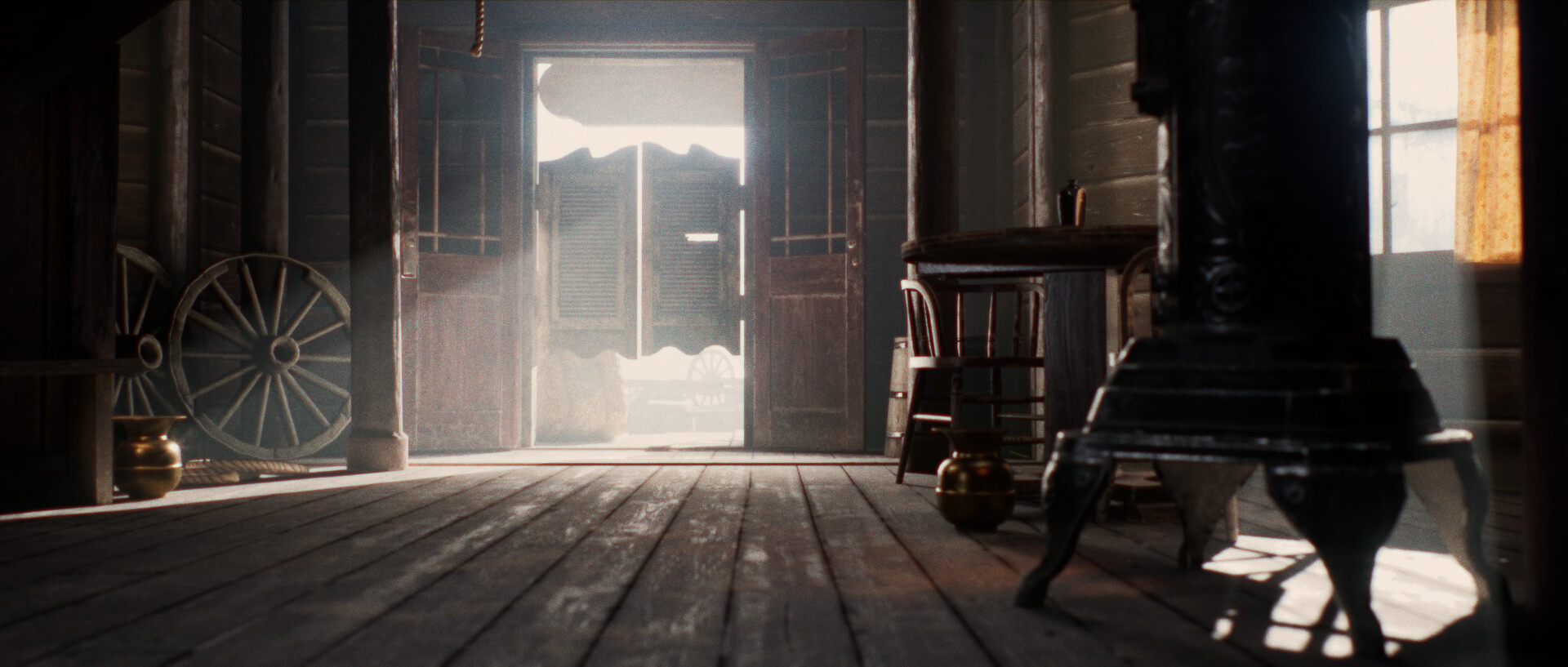
The virtual focal lengths of lenses used were 18mm, 21mm, and 25mm based on a 4-perf Super 35 film size. Most were wide open at T1.3, but a few shots were at T2 for a deeper focus. Aspect ratio of 2.35:1.

Except for the color the sky HDR probe contributes, the two main lighting temperatures used were 5500K for daylight and ~2700K for candle and flame light. A couple of 7500K kick lights were used to give some objects more of a sheen for a particular angle.


To enhance the film emulation look, the red channel was blurred a few pixels to simulate bright light bouncing back up into the lowest layer (cyan, but becomes the red layer in the positive) of negative film.

The trusty convolution bloom was again used for reflection glints off materials.


Every small object was given a local reflection probe so the reflections were accurate at every position for better integration.

I'm not a huge fan of lighting-only shots because I think they can distract from a final result, but I wanted to show how simple the interior lighting is.

Using a real sky HDR probe in the skylight allows complex interactions of colors to happen within the shadows and feels much more realistic.

Because the pools of sunlight are relatively small, the sun bounce light isn't contributing a huge amount. Most of it is being done via the skylight through the windows.

For light baking, I used Luoshuang's GPULightmass for UE4. This uses your Nvidia video card to render the lightmap textures with *insane* lighting detail in a fraction of the time of normal CPU baking. RTX 2060: 1 hour. i9 9900K: 6 hours.